Tableau Next vs Traditional BI: Unlock Better Healthcare Decisions
Published on: 29 July 2026
Author: Annapurna
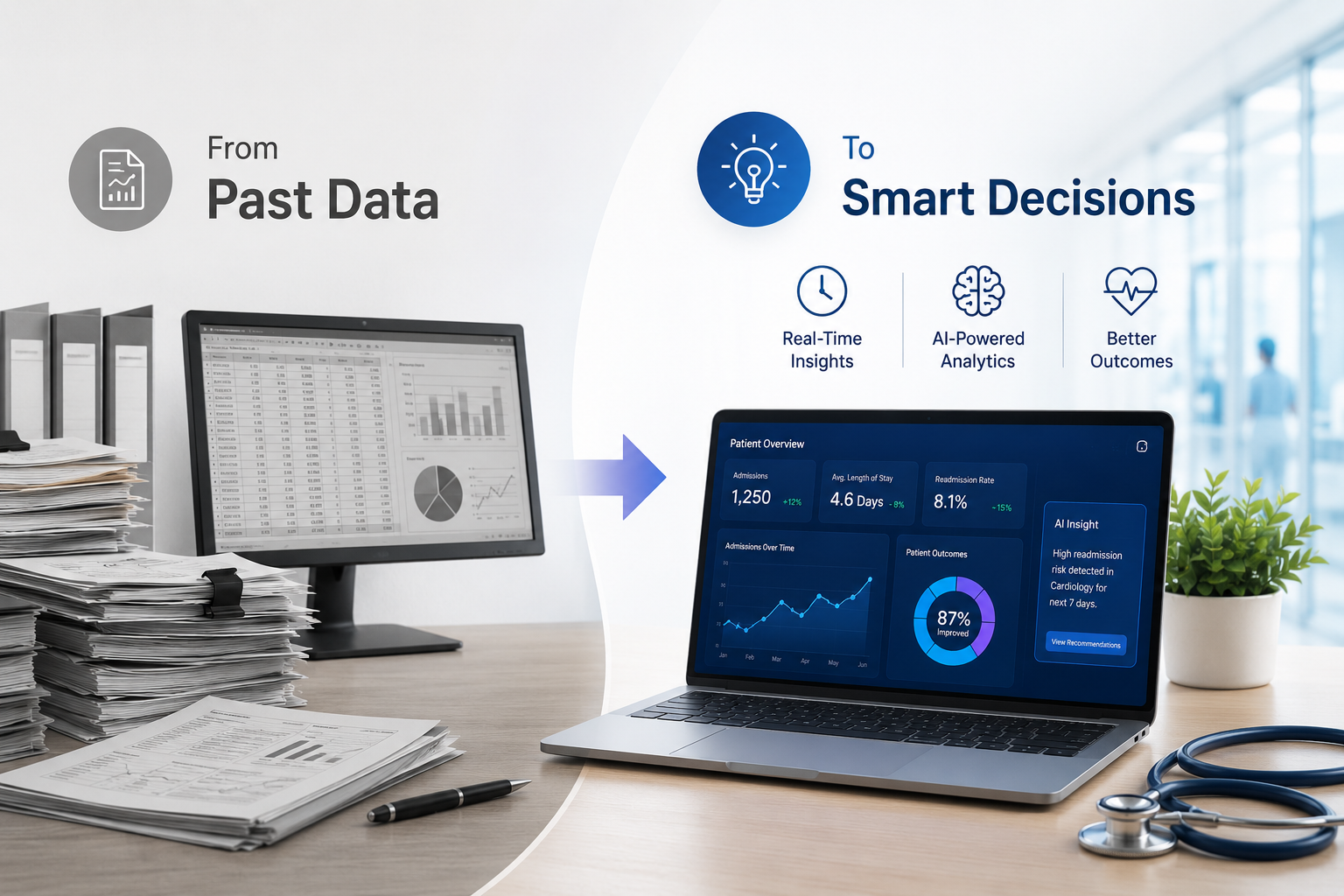
Healthcare organizations generate vast amounts of patient, operational, and financial data, yet nearly 97% of hospital data remains unused due to fragmented legacy systems. Tableau Next bridges this gap by combining Salesforce Data Cloud, unified semantic modeling, and agentic AI through Agentforce. Unlike traditional business intelligence platforms that deliver static, backward-looking reports, Tableau Next provides real-time, conversational analytics directly into clinical workflows. This enables care providers to make faster, AI-driven decisions, optimize patient outcomes, and streamline operations.
What Is Tableau Next?
Tableau Next is Salesforce’s next-generation, agentic analytics platform built natively on the Salesforce ecosystem. It unifies the visual exploration capabilities of traditional Tableau with CRM Analytics, Salesforce Data Cloud, and autonomous AI agents through Agentforce. By embedding a unified semantic layer across enterprise data, Tableau Next translates raw, fragmented data into standardized business and clinical definitions. Users can query complex datasets using natural language, receive proactive alerts, and trigger automated workflows directly where work happens—such as in Electronic Health Record (EHR) interfaces or Slack.
Quick Answer — What is Tableau Next?
Tableau Next is an AI-powered, agentic analytics platform built on Salesforce that integrates visual analytics, Data Cloud, and Agentforce. It simplifies complex data architectures by establishing a single semantic layer, enabling healthcare professionals to query clinical and operational metrics using conversational natural language for faster, context-aware decision-making.
What Is Traditional BI?
Traditional Business Intelligence (BI) refers to legacy reporting architectures that rely on static dashboards, batch-processed ETL (Extract, Transform, Load) pipelines, and centralized data warehousing. In traditional BI environments, data is pulled from disconnected source systems—such as legacy EHRs, billing software, and lab information systems—and processed on scheduled intervals (often nightly or weekly).
While traditional BI provided an important step forward in historical reporting, it requires specialized SQL knowledge or data analyst intervention to modify reports. Consequently, non-technical clinicians and hospital administrators face severe reporting bottlenecks when seeking timely insights.
Key Terminology Definitions

- Tableau Next: An agentic, Salesforce-native analytics engine combining visual analytics, Data Cloud harmonization, and context-aware AI agents.
- Traditional BI: Conventional analytics frameworks dependent on desktop dashboards, batch data refreshes, and manual SQL queries.
- Modern Business Intelligence: Continuous, workflow-embedded intelligence that combines real-time data streaming, unified semantics, and automated insights.
- Healthcare Data Visualization: The graphical representation of clinical, demographic, operational, and financial health data to reveal patterns, trends, and anomalies.
- Decision Intelligence: An emerging discipline that applies AI, machine learning, and contextual business rules to optimize and automate human decision-making processes.
Tableau Next vs Traditional BI: Architectural Comparison
| Capability / Feature | Traditional BI | Tableau Next (Modern BI) |
|---|---|---|
| Data Processing & Architecture | Batch updates; siloes data in rigid data warehouses | Real-time streaming via Salesforce Data Cloud & Data 360 |
| User Interaction | Static, pre-built dashboards; manual filtering | Conversational queries via Agentforce & natural language |
| Data Governance & Semantics | Fragmented logic across separate reports and departments | Centralized, unified semantic layer defined once for all users |
| AI & Predictive Capabilities | Add-on ML plug-ins; backward-looking historical trends | Built-in agentic AI, predictive scoring, and automated action triggers |
| Workflow Integration | Standalone web portals requiring context switching | Embedded natively inside EHRs, Salesforce, Mobile, and Slack |
Quick Answer — How is Tableau Next different from traditional BI?
Tableau Next differs from traditional BI by moving from static, batch-processed dashboards to real-time, agentic decision intelligence. While traditional BI requires manual report creation and SQL skills, Tableau Next uses a unified semantic layer and AI agents to deliver instant, conversational insights directly within daily clinical workflows.
Why Healthcare Needs Modern Business Intelligence
Healthcare organizations operate in complex, high-stakes environments where every minute directly influences patient outcomes and financial sustainability. According to industry research, healthcare organizations generate over 30% of the world's data footprint, yet 97% of hospital data goes completely unused due to legacy silos. Furthermore, Gartner notes that 80% to 90% of healthcare data is unstructured—spanning physician notes, pathology slides, and imaging reports—making it inaccessible to conventional BI dashboards.
Comparing Data Pipelines

- Traditional Healthcare BI Workflow: Raw EHR/Billing Data → Nightly ETL Batch → Static Dashboard → Analyst Review → Delayed Action
- Tableau Next Workflow: EHR/Unstructured Data → Unified Semantic Layer → Agentforce AI → Real-Time Workflow Alert → Immediate Action
Additionally, HIMSS reports that while 85% of healthcare systems are actively exploring AI, only 18% feel structurally ready to deploy it effectively due to poor data readiness. Moving to modern business intelligence enables health systems to unify disparate Electronic Health Record (EHR) platforms, claims systems, and patient monitoring devices into a single, governed data foundation. McKinsey estimates that holistic AI and advanced analytics adoption could unlock $200 billion to $360 billion in annual healthcare savings by optimizing clinical operations and reducing administrative overhead.
Quick Answer — Why is healthcare moving beyond traditional BI?
Healthcare is moving beyond traditional BI because legacy systems cannot process the 80–90% of healthcare data that is unstructured or deliver real-time bedside insights. Modern BI unifies fragmented EHR data, eliminates reporting delays, and provides actionable intelligence that reduces costs and improves patient care.
How Tableau Next Improves Healthcare Decision-Making
To bridge the gap between data collection and clinical execution, health systems require intelligent systems that act as proactive partners. Here is how Tableau Next improves healthcare decision-making across care networks:
- Unified Semantic Context: Through its single semantic layer, Tableau Next ensures that terms like "bed occupancy rate," "readmission risk," or "length of stay" are calculated identically whether viewed by a Chief Medical Officer or a department manager.
- Interactive Healthcare Data Visualization: Next-generation healthcare data visualization converts dense clinical metrics into intuitive, interactive visual stories that clinicians can digest in seconds.
- Conversational Analytics via Tableau Agent: Clinicians can ask questions in plain language—such as "Which ICU beds are projected to open in the next 4 hours?"—and receive immediate, contextual answers and visualizations.
- Actionable Intelligence in the Flow of Work: Rather than forcing nurses and doctors to log into separate reporting portals, insights are embedded directly into their primary interfaces, enabling immediate clinical intervention.
Key Takeaway: Tableau Next transforms raw, fragmented data into governed, actionable decision intelligence, empowering care teams to act faster and with higher diagnostic confidence.
Quick Answer — How does Tableau Next improve healthcare decision-making?
Tableau Next improves decision-making by unifying clinical and administrative data into a single semantic model. Powered by Agentforce, it allows providers to ask complex queries in plain language, surfacing real-time predictive insights and automated alerts directly inside EHR and mobile workflows.
Top Healthcare Use Cases for Tableau Next

1. Patient Care & Emergency Capacity Planning
Emergency departments face unpredictable patient spikes. Tableau Next analyzes real-time triage inputs, admission velocities, and staffing levels to predict bed shortages hours before they occur. Care managers receive proactive alerts on mobile or Slack, allowing them to adjust discharge schedules and reallocate nursing staff dynamically.
2. Operational Efficiency & Staffing Optimization
Nurse burnout and overtime costs represent significant operational strains. By combining historical shift patterns, patient acuity scores, and seasonal illness trends, Tableau Next assists shift managers in building optimized coverage schedules that match patient demand without overworking staff.
3. Financial Management & Claims Denial Reduction
Unprocessed claims and initial denials account for hundreds of billions in lost revenue annually across health networks. Tableau Next identifies coding discrepancies, missing pre-authorizations, and payer billing trends in real time, enabling revenue cycle teams to rectify errors before claim submission.
Overview of Core Healthcare Impact Areas
- Patient Care: Bed availability prediction, real-time readmission risk scoring, triage optimization.
- Operations: Dynamic shift scheduling, resource allocation, bottleneck reduction.
- Finance: Denial prevention, automated billing checks, revenue cycle optimization.
Quick Answer — What are the top healthcare use cases?
Top healthcare use cases for Tableau Next include emergency department bed capacity management, predictive nurse staffing, real-time patient readmission risk scoring, and revenue cycle optimization to prevent claims denials.
Does Tableau Next Support AI-Powered Analytics?
Yes, Tableau Next is purpose-built as an agentic, AI-first analytics platform. By integrating natively with Salesforce Agentforce and Einstein AI, it goes beyond traditional generative AI text outputs. It dynamically generates custom visualizations, executes root-cause diagnostics, and suggests follow-up actions grounded in enterprise data governance.
Quick Answer — Does Tableau Next support AI-powered analytics?
Yes, Tableau Next features native, agentic AI capabilities powered by Salesforce Agentforce and Data Cloud. It delivers autonomous data synthesis, natural language querying, automated anomaly detection, and predictive modeling with built-in enterprise data governance.
Migration Best Practices: Moving from Traditional BI to Tableau Next
Transitioning from a legacy reporting system to an agentic analytics platform requires a deliberate, structured approach:

- Audit Existing Reports: Catalog legacy dashboards and eliminate redundant or unused reports to focus migration efforts on high-impact clinical metrics.
- Establish a Unified Semantic Layer: Utilize Salesforce Data Cloud and Tableau Semantics to define key health performance metrics once across the enterprise.
- Prioritize Data Governance & HIPAA Compliance: Ensure robust role-based access controls and zero-trust data protection standards before training AI models on patient data.
- Embed Insights in Workflow: Deploy visualizations directly into EHR screens, communication hubs like Slack, or mobile applications used by on-duty clinicians.
- Enable Users Through Continuous Training: Train clinical and administrative staff on conversational prompting techniques to maximize self-service analytics adoption.
Read More: Learn how to streamline your enterprise data transition with our detailed guide on Tableau Integration Services and Best Practices. For deeper integration with Salesforce architectures, explore our insights on Implementing Salesforce Data Cloud for Healthcare.
Conclusion
The shift from traditional BI to Tableau Next represents a fundamental evolution in how health systems leverage data. By unifying clinical records, operational metrics, and agentic AI into a seamless decision intelligence engine, Tableau Next empowers care teams to eliminate administrative bottlenecks and elevate patient care.
Ready to transform your healthcare analytics foundation and unlock better clinical decisions?
Talk to our experts today at Tableau to explore a customized Tableau Next implementation strategy for your organization.